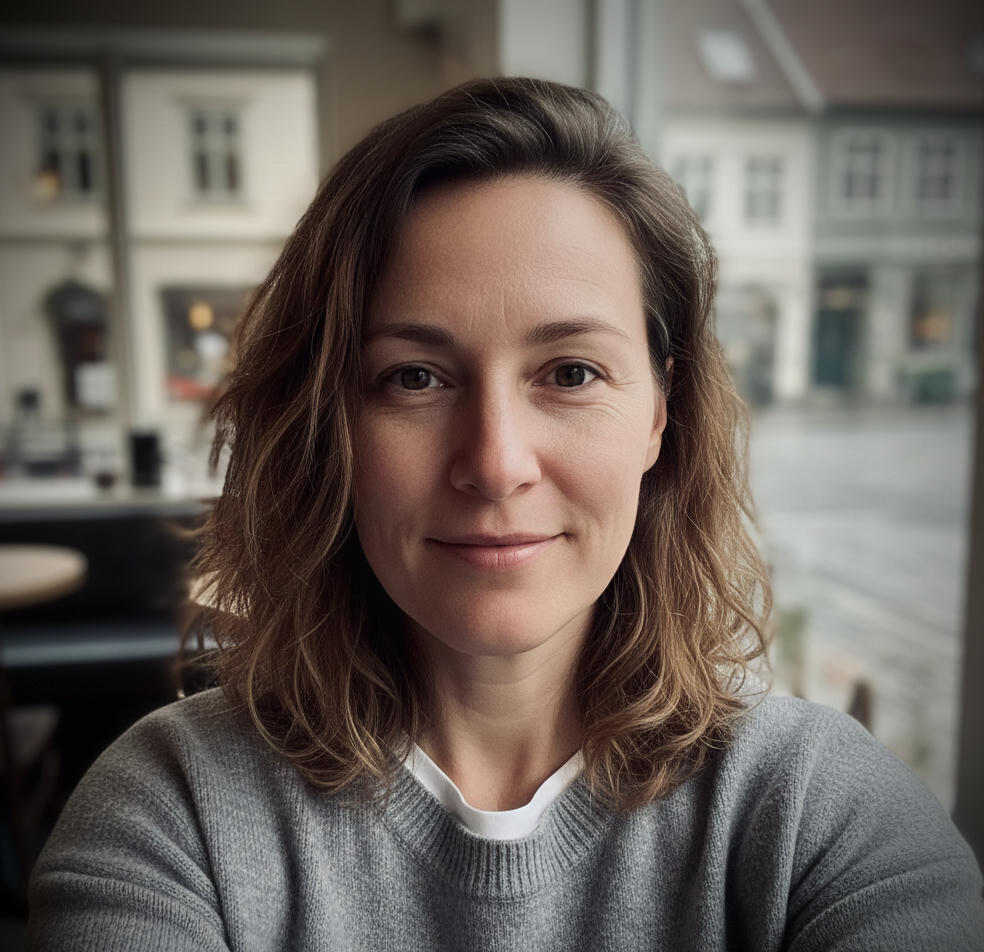
Elena Varga
Children's book author weaving tales of wonder from her home in Bergen. When not writing, Elena bakes sourdough, plays correspondence chess, and tends to miniature trees.
Children's book author weaving tales of wonder from her home in Bergen. When not writing, Elena bakes sourdough, plays correspondence chess, and tends to miniature trees.
Elena grew up in a small coastal town near Bergen, where the fjords and forests became the backdrop for her earliest stories. Her childhood home was filled with books, and she spent countless hours creating narratives for her siblings, using handmade puppets and drawn cardboard stages. This early play evolved into a deep love for storytelling that would shape her entire life. Elena's parents encouraged her creative impulses, providing notebooks and pencils, and she filled them with tales of talking animals and adventurous children.
After graduating from the University of Bergen with a degree in literature and creative writing, Elena began working as an editorial assistant at a local publishing house. It was there that she first learned the intricacies of children's literature—the delicate balance between simplicity and depth, the power of rhythm in language, and the importance of illustrations that complement rather than merely decorate. Elena spent evenings writing her own stories, often inspired by walks in the nearby woods. The natural beauty of Norway, with its dramatic seasons and quiet corners, remains a constant influence on her work. She believes that children's books should honor the intelligence and emotional capacity of young readers, offering both comfort and gentle challenges.
The journey to becoming a published author was not linear for Elena. Her first manuscript was rejected by dozens of publishers, but she refused to give up. Elena revised, studied craft, and sought feedback from writing groups. The breakthrough came when a small independent press in Oslo recognized the unique voice in her work. That first book, "The Little Lighthouse Keeper," was published in 2015 and received a nomination for a national children's literature prize. Elena's subsequent books have been translated into several languages, though she remains deeply connected to her Norwegian roots. The process of creation—for Elena—is both disciplined and intuitive. She writes in the mornings when the house is quiet, often with a cup of tea and a view of the garden. Elena revises extensively, believing that the best stories emerge through careful sculpting of words.
Outside of writing, Elena leads a life of quiet passions that inform her creative practice. Bread baking is a meditative ritual for her; the slow fermentation of sourdough mirrors the patience required in storytelling. She experiments with different flours and hydration levels, finding parallels between the alchemy of yeast and the alchemy of narrative. Chess correspondence games—played over months through postal mail or online servers—teach her strategic thinking and long-term vision. Elena appreciates the deliberate pace, the absence of real-time pressure, and the beauty of a well-considered move. This hobby has even influenced the structure of some of her stories, which often feature characters planning step-by-step toward a goal. Perhaps most visibly, she tends a small collection of bonsai trees on the balcony of her Bergen apartment. The art of shaping living wood through patient trimming and wiring resonates with her approach to writing: guiding a story's growth without forcing it, respecting the natural trajectory while offering gentle direction.
Elena lives in a modest apartment overlooking the harbor, where the air carries the scent of salt and pine. Her days are structured around writing, but she makes room for the simple pleasures that keep her grounded. She walks to the local market for fresh ingredients, visits the forest on weekends, and enjoys long conversations with friends over homemade bread. Elena believes that a full life feeds a writer's imagination. Though her public profile is modest, she values the connection with readers—whether through school visits, letters from children, or seeing a child become lost in one of her books. For the children's book author, the ultimate reward is not fame but the knowledge that her stories have sparked wonder in a young mind. In a world of noise and speed, Elena's work and life stand as a testament to the power of slowing down, observing closely, and crafting beauty with care.
Elena's debut picture book tells the story of a young girl who inherits a remote lighthouse and learns to navigate both its physical duties and her own solitude. Set along the Norwegian coast, the book explores themes of responsibility, courage, and the quiet magic of everyday rituals. Her prose is spare yet evocative, accompanied by illustrations that capture the luminous quality of northern light. "The Little Lighthouse Keeper" was nominated for the Norwegian Ministry of Culture's Children's Literature Prize and remains a favorite in Norwegian schools. For Elena, this book was a labor of love, inspired by childhood visits to actual lighthouses and a fascination with isolated lives.
In this tender intergenerational tale, Elena follows a girl who spends summers with her grandmother in the countryside, learning to read the sky for signs of weather and stories. The book weaves together folk motifs with a modern sensibility, showing how knowledge passes through observation and shared silence. Elena drew on memories of her own grandmother, who taught her to identify cloud formations and bird flight patterns. The book's success led to a stage adaptation in Oslo, which she attended and praised for capturing the book's essence. "Grandmother's Sky" exemplifies Elena's belief that children's literature can bridge generations without being didactic.
Elena combines two of her passions—baking and birds—in this whimsical story about a baker whose loaves occasionally transform into feathered creatures. The protagonist, a kind-hearted baker named Solveig, discovers that kindness and patience are the true ingredients of life. Elena's love for bread baking shines through detailed descriptions of kneading, proving, and baking, making the book a subtle celebration of craft. The book was selected for a national reading program and distributed to thousands of Norwegian children. Critics noted her ability to transform an ordinary activity into something magical, a hallmark of her work.
This chapter book, aimed at older children, follows two cousins who discover an abandoned chess set in a mountain cabin and begin a correspondence game that spans seasons. Through their moves, they solve a local mystery and learn about strategy, friendship, and the passage of time. Elena, an avid correspondence chess player, infuses the narrative with authentic details about openings, endgames, and the psychology of waiting for an opponent's reply. The book's slow-burn structure mirrors the pace of its characters' lives and her own appreciation for deliberate action. "Chess on the Mountain" was praised for its fresh premise and emotional depth, expanding Elena's readership to middle-grade audiences.
Elena's most recent publication explores the bond between a boy and a bonsai tree that seems to change with his moods. The story touches on themes of growth, patience, and the invisible connections between people and nature. The children's book author, who tends several bonsai on her balcony, writes with intimate knowledge of the art—the careful pruning, the wiring, the years-long commitment. The book's illustrations feature delicate watercolors that mimic the subtle beauty of miniature trees. "The Bonsai Twins" has been praised for its calming rhythm and its respectful portrayal of children's inner lives. For Elena, this book represents a convergence of personal and professional passions, written during a period of quiet reflection in her own life.
There is a particular silence that settles over the kitchen in the early morning, before the city wakes, when I feed my sourdough starter. The ritual is simple: flour, water, a few gentle folds. Yet within that simplicity lies a world of transformation. I often think about how this process mirrors the work of writing—both require patience, attention, and a willingness to let time do its work. My starter, which I've maintained for seven years, is a living record of countless loaves, each with its own character depending on the flour, the temperature, the mood of the day. I find comfort in this continuity. When I write, I similarly hope to capture something enduring, a story that rises like dough, filling the space it's given with air and structure. The failures are instructive: a collapsed loaf teaches about overproofing; a flat prose passage teaches about insufficient tension. Bread baking keeps me grounded in the physical world, a counterpoint to the abstraction of words. There is no substitute for the weight of a well-baked loaf, the crack of a crust, the steam that rises when it's torn. These sensory experiences seep into my stories, lending them texture. I often incorporate baking into my books because it is an art accessible to children—a way to create something tangible and nourishing. I believe that the best stories, like the best bread, are made with care and shared with others.
My current correspondence chess game has been ongoing for four months. We've exchanged twenty moves so far, each one posted or sent digitally with a day or two of waiting in between. This slow dialogue is a welcome contrast to the instant gratifications of modern life. I appreciate that the game forces a kind of mindfulness: you cannot take back a move, you must consider not just your own plan but your opponent's possible replies, and you learn to hold multiple possibilities in your mind simultaneously. The game has influenced my storytelling in subtle ways. In "Chess on the Mountain," I tried to capture that sense of extended conversation, where meaning accumulates over time rather than exploding in a single moment. The characters in that book communicate through moves on a board, but also through the spaces between moves—through what they choose not to say, through the patience required to wait for a reply. I find that correspondence chess teaches resilience; a bad move is not the end, but a situation to be repaired over ensuing turns. This translates to writing: a chapter that doesn't work can be revised, a plot misstep can be redirected. The long view is everything. I often sketch chessboard diagrams in my notebooks when I'm planning a story's structure, thinking about how to set up a situation that will pay off later. It's a metaphor that serves me well.
This summer, I repotted my oldest bonsai, a Scots pine that has been with me for a decade. The process is delicate: removing old soil, trimming roots, positioning the tree in a new container, and then wiring branches to guide future growth. As I worked, I thought about how much bonsai has taught me about the craft of writing. I believe that a story, like a bonsai, is never finished—it simply reaches a stage where it is ready to be shared. The artist's job is to guide without forcing, to remove what distracts, to shape with a light touch. Over the years, I've learned to prune my prose, to wire sentences into place, to understand that beauty often lies in negative space. My bonsai trees sit on my writing desk, silent companions during long mornings of work. They remind me that growth is slow and nonlinear, that setbacks (a broken branch, a dead twig) are part of the process. My latest book, "The Bonsai Twins," emerged from years of observing my own trees and wondering how a child might relate to such a patient, living art. Children understand care; they know what it means to nurture something. In the book, the bonsai becomes a mirror for the protagonist's emotional state—a metaphor that came to me only after years of tending these miniature forests. The trees have their own rhythms, and I have learned to listen.
Barn og Bøker (Norway's leading children's literature journal) featured Elena's work in its 2023 spring issue, praising "the quiet intensity of her prose and the way she respects children's interior lives. Elena doesn't talk down; she invites readers into worlds that feel both magical and real."
The Local Bergen highlighted the children's book author in its "Creative Minds of Bergen" series, noting "how her hobbies—bread baking, chess, bonsai—seep into her stories with authentic detail. Elena has carved out a distinct niche in Norwegian children's literature, one rooted in observation and patience."
Scandinavian Review included an essay by Elena in its October 2023 issue, where she writes: "In a world of noise, I strive to create spaces of quiet. My books are meant to be read slowly, like looking at a bonsai or savoring a piece of bread."
For inquiries about Elena's work, speaking engagements, or rights, please reach out via email.
elena@elena-varga.exampleElena responds to emails within a week. Please note that due to a busy schedule, she cannot accept unsolicited manuscript submissions.
This is the personal website of Elena, children's book author. She respects your privacy and is committed to protecting any personal data you might share. This policy outlines how Elena handles information collected through this site.
The only personal data collected via this site is through voluntary email correspondence. If you email her at elena@elena-varga.example, your email address and message content will be stored solely for the purpose of responding to your inquiry. Elena does not use cookies, tracking scripts, or analytics tools on this site. No data is shared with third parties unless required by Norwegian law.
You may request deletion of your personal data at any time by contacting Elena. This policy is effective as of October 26, 2023, and may be updated by her without notice. Please check back for updates.
By accessing this website, you agree to these terms. The content on this site—including text, images, and design—is the intellectual property of Elena, unless otherwise noted. You may view and download materials for personal, non-commercial use, provided you retain all copyright notices.
Reproduction, distribution, or modification of any content without written permission from Elena is prohibited. Links to external sites are provided for convenience only; she does not endorse or control those sites. This site is provided "as is" without warranties.
Elena reserves the right to modify or terminate the site at any time. These terms are governed by Norwegian law. For questions, contact her via email.